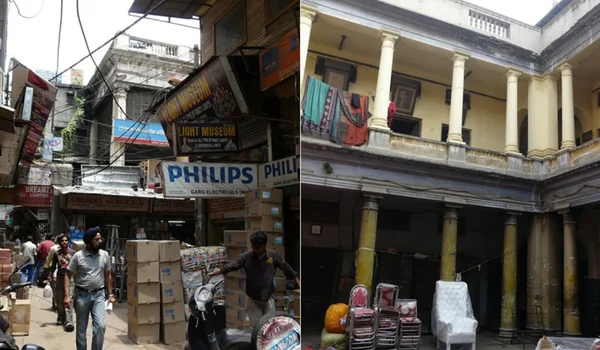
Bhagirath Palace is one of the most unusual heritage properties in Old Delhi because its identity today is closely connected with commerce rather than tourism. Located in the Chandni Chowk area, the historic building is associated with Begum Samru’s palace and is now surrounded by one of Delhi’s best-known wholesale markets for electrical goods, lighting products and related merchandise. The National Mission on Monuments and Antiquities records Bhagirath Palace as a built-heritage site dating to the 19th–20th century period, with 1823 noted as its sub-period.
For Corporate Palace, Bhagirath Palace is particularly interesting because it demonstrates how a historic palace can evolve into a major commercial destination while still retaining traces of its architectural past.
Quick Information
| Information | Details |
| Name | Bhagirath Palace |
| Also Associated With | Begum Samru’s Palace / Begum Samru Haveli |
| Location | Chandni Chowk, Old Delhi |
| District | Central Delhi |
| PIN Code | 110006 |
| Property Type | Historic built heritage and commercial market |
| Historical Period | 19th–20th century; NMMA records 1823 as sub-period |
| Historical Association | Begum Samru |
| Present Use | Wholesale and retail commercial market |
| Famous For | Electrical goods, lighting and commercial trade |
| Market Character | Wholesale and retail |
| Entry Fee | No general entry fee |
| Typical Market Hours | Around 10 AM–7/8 PM, Monday–Saturday |
| Weekly Closure | Sunday for most shops |
| Nearest Metro | Chandni Chowk and Lal Quila |
| Nearby Landmark | Red Fort |
The exact opening and closing times can vary from shop to shop, so buyers should confirm with individual sellers before travelling.
Where Is Bhagirath Palace Located?
Bhagirath Palace is located in Chandni Chowk in Old Delhi, within the historic Shahjahanabad area.
The National Mission on Monuments and Antiquities identifies the built heritage site around Central Bank of India in Chandni Chowk. Electoral records also identify Bhagirath Palace as a locality within the Chandni Chowk area.
The surrounding area is one of the busiest commercial parts of Old Delhi. Visitors will find narrow lanes, wholesale shops, warehouses, traders and markets dealing in different categories of goods.
Its location also puts it close to several major historic attractions, making Bhagirath Palace different from an isolated heritage property.
History of Bhagirath Palace
The story of Bhagirath Palace is closely connected with Begum Samru, a prominent 18th- and early-19th-century personality who became an influential political and military figure in North India.
Historian Swapna Liddle has written that Begum Samru acquired the land where the palace stands in 1807. Historical accounts connect her with Walter Reinhardt, the European military adventurer popularly associated with the name “Sombre” or “Samru.”
The National Mission on Monuments and Antiquities separately records the present Bhagirath Palace built heritage site with a period extending through the 19th–20th centuries and notes 1823 AD as its sub-period.
This distinction is useful because different accounts describe the history of the site and its building phases differently. Rather than assigning one unsupported construction date, it is safer to understand Bhagirath Palace as a historic complex whose present architectural form developed over time.
From Begum Samru’s Palace to Bhagirath Palace
The property was eventually associated with Seth Bhagirath Mal, who purchased the palace in 1940 and gave it the name by which it is now commonly known.
Over time, its character changed substantially. Instead of functioning as a private palace, the complex became part of the commercial fabric of Old Delhi.
Today, electrical shops, medical and surgical businesses, drugstores and other commercial establishments operate in and around the complex.
This transformation is one of the most important aspects of Bhagirath Palace’s story.
Bhagirath Palace and Begum Samru
Begum Samru is central to understanding the historical importance of the property.
She was an unusual figure in the political landscape of late-18th and early-19th-century North India. From a difficult early life, she rose to considerable influence and eventually controlled the principality of Sardhana.
Her association with European military forces and the East India Company also makes her story different from the conventional narratives surrounding royal palaces.
The palace in Chandni Chowk therefore represents more than an old building. It is connected with the political and social history of Delhi during a period when Mughal authority, regional powers and British influence were interacting and changing rapidly.
Bhagirath Palace Architecture
Bhagirath Palace does not present itself today like a preserved royal palace or museum. Much of the complex has been absorbed into its commercial surroundings.
However, historical architectural documentation provides evidence of its older character.
An Archaeological Survey review described the palace as having massive columns, a spacious verandah and decorative capitals. The report also noted that later alterations were made when the building was occupied by the British, including additions associated with its use as a Residency.
Historical descriptions also mention:
- Large columns
- Verandahs
- Brick and plaster construction
- Lakhori bricks
- Decorative capitals
- Earlier halls
- Basement cells
- Elements associated with later British modifications
Some of these original architectural features remain visible despite the building’s commercial transformation.
What Makes Bhagirath Palace Unique?
The biggest attraction of Bhagirath Palace is not simply its age.
It is the combination of heritage and commerce.
A visitor can walk through one of Delhi’s busiest electrical markets while standing within a complex associated with Begum Samru and the political history of early-19th-century Delhi.
This creates an unusual relationship between:
- Heritage
- Wholesale trade
- Old Delhi architecture
- Local employment
- Electrical commerce
- Tourism
- Urban redevelopment
Few heritage properties have such a direct connection with a large modern trading ecosystem.
Bhagirath Palace as an Electrical Market
Today, the name Bhagirath Palace is perhaps more strongly associated with electrical and lighting products than with its palace history.
The market is known for products such as:
- Electrical fittings
- Lights
- Decorative lighting
- LED products
- Wires and cables
- Switches
- Electrical accessories
- Commercial lighting equipment
- Other electrical merchandise
The market attracts wholesalers, retailers, contractors, electricians, interior professionals and ordinary buyers.
Government commercial records also contain numerous businesses using Bhagirath Palace addresses, reflecting the area’s long-standing commercial character.
Why Is Bhagirath Palace Important for Businesses?
Bhagirath Palace is particularly relevant to Corporate Palace because it demonstrates the economic value of a historic commercial district.
The palace and its surrounding market support an ecosystem involving:
- Electrical wholesalers
- Retailers
- Lighting suppliers
- Contractors
- Electricians
- Interior designers
- Builders
- Event decorators
- Wedding suppliers
- Transporters
- Packaging and logistics workers
- Warehouse operators
- Commercial property owners
These businesses are not necessarily operated by the palace itself. Rather, they form part of the wider commercial ecosystem that has developed around Bhagirath Palace.
Wedding and Event Economy
The lighting trade has an indirect connection with Delhi’s enormous wedding and event industry.
Decorative lights, electrical fittings and temporary lighting equipment are required for:
- Weddings
- Banquets
- Festivals
- Exhibitions
- Retail displays
- Restaurants
- Hotels
- Corporate events
This gives Bhagirath Palace an economic connection that extends far beyond the Chandni Chowk market itself.
Heritage Conservation and Commercial Pressure
Bhagirath Palace also highlights an important challenge for India’s historic commercial buildings: how can heritage structures remain economically useful without losing their architectural character?
Reports have documented deterioration in parts of the building, including cracks, damaged ceilings and deterioration of plaster and columns.
At the same time, the property continues to function as part of a busy commercial market.
The National Mission on Monuments and Antiquities officially lists Bhagirath Palace as built heritage. A Delhi Heritage Conservation Committee response also states that the whole of Bhagirath Place, Chandni Chowk, was included in a heritage-declared area.
This makes conservation particularly complicated. Any restoration effort has to consider both the historic character of the property and the commercial activity that now depends on the area.
Finance and Investment Perspective
Bhagirath Palace should not be presented as a conventional palace investment opportunity.
There is no reliable basis for giving a specific property price, expected rental return or ROI for the historic complex.
Instead, its financial importance can be understood through the commercial ecosystem around heritage markets.
Historic commercial locations can create economic value through:
- Wholesale trade
- Retail activity
- Commercial rentals
- Tourism
- Local employment
- Supply chains
- Transportation
- Heritage-led redevelopment
For investors and urban planners, Bhagirath Palace illustrates the broader question of how heritage properties can remain economically productive while receiving appropriate conservation attention.
Insurance Considerations for a Historic Commercial Property
Historic buildings used for commercial purposes can face a different risk profile from ordinary modern shops.
Depending on ownership and occupancy arrangements, relevant insurance considerations may include:
- Property insurance
- Fire insurance
- Public liability insurance
- Business interruption cover
- Equipment insurance
- Stock insurance
- Restoration-related risks
These are general considerations and should not be interpreted as confirmation that Bhagirath Palace itself holds any particular insurance policy.
Bhagirath Palace Market Timings
Available market sources generally place trading hours around the late morning to evening period, with most shops operating from Monday to Saturday and Sunday being the main weekly closure.
| Day | Typical Market Status |
| Monday | Generally open |
| Tuesday | Generally open |
| Wednesday | Generally open |
| Thursday | Generally open |
| Friday | Generally open |
| Saturday | Generally open |
| Sunday | Most shops closed |
Different shops can follow different schedules. Some sources list approximately 10 AM–7 PM, while others give a broader 10 AM–8 PM range. Festival-season hours can also change.
For a specific shop or bulk purchase, it is best to confirm the timing before visiting.
Entry Fee
There is no general tourist entry ticket for Bhagirath Palace market.
It functions primarily as a commercial market rather than a ticketed museum or monument. Visitors can enter the market area for shopping, although access to individual commercial premises depends on the shop.
How to Reach Bhagirath Palace
By Metro
Metro is one of the most practical ways to reach Bhagirath Palace.
Chandni Chowk Metro Station on the Yellow Line and Lal Quila Metro Station on the Violet Line are useful stations for reaching the market. Depending on the exact destination within Bhagirath Palace, the remaining journey can be completed on foot or by local transport.
By Train
Old Delhi Railway Station is nearby, making the market convenient for people arriving from other parts of Delhi and the surrounding region.
By Road
Visitors can reach the Chandni Chowk area by bus, auto-rickshaw, taxi and other local transport.
However, driving a private car deep into the market is generally inconvenient because of narrow lanes, congestion and limited parking.
Nearby Places
Bhagirath Palace is surrounded by some of Old Delhi’s most important historic and commercial destinations.
Useful nearby places include:
- Red Fort
- Chandni Chowk
- Jama Masjid
- Dariba Kalan
- Chawri Bazaar
- Old Delhi Railway Station
- Lajpat Rai Market
- Fatehpuri area
This makes Bhagirath Palace suitable for visitors who want to combine shopping with an Old Delhi heritage walk.
Best Time to Visit Bhagirath Palace
For shopping, weekday mornings or early afternoons are generally more practical because the market is active but the visitor can avoid some of the heavier late-day congestion.
The market becomes especially busy before festivals such as Diwali because decorative lighting demand increases.
For visitors interested in the heritage side of Bhagirath Palace, a weekday visit can also make it easier to observe the building’s surviving architectural elements without the extreme crowds associated with peak shopping periods.
Things to Know Before Visiting
Before visiting Bhagirath Palace, keep these points in mind:
- It is primarily a working commercial market, not a conventional tourist palace.
- Most shops are generally closed on Sunday.
- Timings can differ from one shop to another.
- The market can become extremely crowded during festival and wedding seasons.
- Metro or public transport is usually more convenient than taking a private car.
- Narrow lanes can make movement difficult for large groups.
- If buying electrical products in bulk, compare specifications and warranties before purchasing.
- Visitors interested in heritage should respect commercial activity and avoid entering restricted shop or building areas.
FAQs
- Where is Bhagirath Palace located?
Bhagirath Palace is located in Chandni Chowk, Old Delhi, in Central Delhi, PIN code 110006.
- Why is Bhagirath Palace famous?
It is famous both for its historical association with Begum Samru and for the major electrical and lighting market that operates in and around the property today.
- Was Bhagirath Palace the palace of Begum Samru?
The historic property is widely identified with Begum Samru’s palace or haveli. Historical research places her acquisition of the site in 1807, while official heritage records separately document the surviving built heritage.
- What can I buy at Bhagirath Palace?
The market is particularly known for electrical and lighting products, including lights, decorative lighting, wires, switches and other electrical merchandise.
- Is Bhagirath Palace open on Sunday?
Most shops in the market are generally closed on Sunday, although individual businesses may follow their own schedules.
- Which metro station is nearest to Bhagirath Palace?
Chandni Chowk Metro Station and Lal Quila Metro Station are both practical metro options. Lal Quila is particularly close to the Bhagirath Palace area according to current public-transit information.
Final Thoughts
Bhagirath Palace is one of Delhi’s most fascinating examples of the meeting point between heritage and commerce. Its connection with Begum Samru gives the property an important place in the history of Old Delhi, while its present-day identity comes largely from the busy electrical and lighting market that surrounds and occupies the complex. The National Mission on Monuments and Antiquities recognises Bhagirath Palace as built heritage, making its continued existence significant beyond its commercial value.
For Corporate Palace, Bhagirath Palace is especially important because it shows that a palace does not always survive as a museum, royal residence or heritage hotel. Sometimes, its story continues through an active marketplace. The challenge is to preserve that historic identity while allowing the commercial ecosystem that has grown around it to continue serving Delhi’s economy.