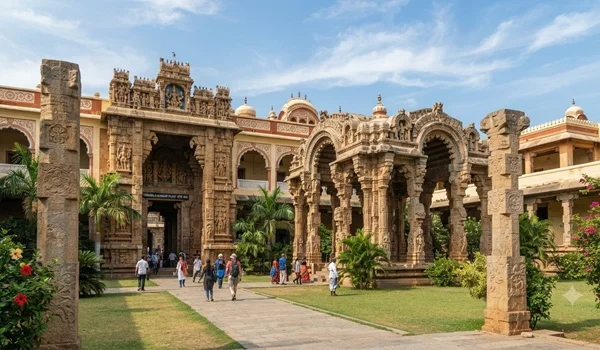
Thirumalai Nayakkar Palace, also known as Thirumalai Nayakar Mahal, is one of the most important historic monuments in Madurai, Tamil Nadu. Built in the 17th century during the reign of King Thirumalai Nayak, the palace is recognised for its enormous pillars, elaborate stucco work, grand courtyard and distinctive combination of architectural influences. The present structure is only a part of the much larger palace complex that existed historically. Today, the monument is protected by the Archaeology Department and is an important part of Madurai’s heritage tourism circuit. Its location near the Meenakshi Amman Temple makes it particularly convenient for visitors exploring the city’s major historic attractions.
Quick Information
| Information | Details |
| Palace Name | Thirumalai Nayakkar Palace / Thirumalai Nayakar Mahal |
| Location | Madurai, Tamil Nadu |
| City | Madurai |
| State | Tamil Nadu |
| Built | 17th century; commonly dated to 1636 |
| Built By | King Thirumalai Nayak |
| Dynasty | Madurai Nayak Dynasty |
| Architectural Style | Blend of Dravidian and Islamic influences |
| Property Type | Historic palace monument |
| Present Use | Heritage monument and tourist attraction |
| Known For | Giant pillars, courtyard, stucco work and historic architecture |
| Important Sections | Swarga Vilasam and Ranga Vilasam |
| Nearby Landmark | Meenakshi Amman Temple |
| Best Time to Visit Madurai | September to March |
Tamil Nadu Tourism describes the palace as a major Madurai attraction and notes its large pillars, courtyard, architectural details and museum displays.
Where Is Thirumalai Nayakkar Palace Located?
Thirumalai Nayakkar Palace is located in Madurai city, Tamil Nadu. It is situated in the historic central part of the city and is approximately 2 km southeast of the Meenakshi Amman Temple according to Tamil Nadu Tourism information.
The palace’s location makes it easy to include in a heritage-focused Madurai itinerary. Visitors can combine it with the Meenakshi Amman Temple and other historic attractions in the city.
Madurai itself is an important cultural and commercial centre of southern Tamil Nadu. The city is also known for its long association with Tamil culture, temples, traditional markets and historic architecture.
History of Thirumalai Nayakkar Palace
The palace was built during the reign of King Thirumalai Nayak, who ruled the Madurai Nayak kingdom from 1623 to 1659. Tamil Nadu Tourism identifies him as one of the important rulers associated with Madurai’s development and architectural heritage.
The palace was originally much larger than the structure visible today. Historical changes over the following centuries resulted in substantial portions of the original complex being removed or altered. Tamil Nadu Tourism notes that the palace’s original extent was around four times the portion that survives today.
The palace was designed as a grand royal complex containing spaces associated with court life, residences, entertainment and administration. The surviving structure provides an important glimpse into the architectural ambitions of the Madurai Nayak period.
Later restoration work helped preserve the remaining structure. Tamil Nadu Tourism records restoration associated with Lord Napier’s administration during the 19th century.
Architecture of Thirumalai Nayakkar Palace
The architecture is the palace’s most distinctive feature.
The building demonstrates a combination of Dravidian and Islamic architectural influences, with large-scale arches, domes, ornamental stucco work and monumental columns. Tamil Nadu Tourism also describes a Rajput influence in its broader architectural character.
Massive Pillars
The enormous pillars are among the first features visitors notice. Tamil Nadu Tourism states that some of the pillars reach approximately 82 feet in height and 19 feet in width.
Their scale gives the palace its monumental appearance and helps visitors understand the engineering and architectural ambitions of the Nayak period.
Central Courtyard
A large central courtyard forms one of the major visual elements of the surviving palace. The courtyard is surrounded by massive circular pillars and provides an open space within the palace complex.
Stucco Work
The palace is also recognised for decorative stucco work on its arches and domes. Traditional materials including brickwork and shell lime, known as chunnam, were used in its construction and finishing.
Swarga Vilasam and Ranga Vilasam
The palace complex is described in two principal sections known as Swarga Vilasam and Ranga Vilasam. These spaces formed part of the larger royal complex.
What Can You See at Thirumalai Nayakkar Palace?
A visit to the palace is mainly about experiencing its architecture and understanding its historical setting.
Important features include:
- Grand central courtyard
- Massive circular pillars
- Decorative arches
- Stucco ornamentation
- Domed architectural elements
- Historic palace chambers
- Dancing hall
- Gallery and museum displays
- Royal architectural remains
- Gardens and open areas
Tamil Nadu Tourism also notes collections such as ancient jars, statues, pots, coins, inscriptions and tools in the museum area.
The palace’s surviving royal features and monumental scale make it particularly useful for students, history enthusiasts, architecture enthusiasts and cultural tourists.
Museum and Cultural Importance
The museum associated with the palace adds an educational element to the visit. Visitors can see historical objects and displays connected with the region’s cultural past.
The palace is also used as a cultural tourism destination and has featured in tourism programmes organised around Madurai and Tamil Nadu. Government tourism material continues to include Thirumalai Nayakar Palace among the city’s important heritage attractions.
Light and Sound Show
The palace is also known for its evening light and sound presentation. Tamil Nadu Tourism describes an evening programme depicting the story of Kannagi.
Because show schedules can change, visitors should confirm the current programme, language, ticketing arrangements and timings before planning specifically around the light and sound show.
Thirumalai Nayakkar Palace Timings
Current visitor timings can change because of maintenance, government arrangements, special events or seasonal programmes. Tamil Nadu Tourism confirms that the palace is open during the day for visitors to explore the monument and museum, with evening programming also described on its tourism page.
For a visit in 2026, it is advisable to verify the latest opening hours and any special closure information before travelling.
| Day | Visitor Information |
| Monday | Verify current timings before visiting |
| Tuesday | Verify current timings before visiting |
| Wednesday | Verify current timings before visiting |
| Thursday | Verify current timings before visiting |
| Friday | Verify current timings before visiting |
| Saturday | Verify current timings before visiting |
| Sunday | Verify current timings before visiting |
This approach is preferable to relying on an outdated fixed timetable.
Thirumalai Nayakkar Palace Entry Fee
Entry charges may change over time and can differ depending on visitor category or additional programmes such as the light and sound show.
A reliable current 2026 ticket schedule was not established from the available official tourism information, so a fixed entry fee should not be assumed. Visitors should confirm the applicable ticket price at the time of planning their visit.
How to Reach Thirumalai Nayakkar Palace
By Air
Madurai Airport is the nearest airport. Tamil Nadu Tourism gives the airport distance as approximately 10–16 km depending on the tourism information page and route considered.
By Train
Madurai Junction is the nearest major railway station. Tamil Nadu Tourism places it only a few kilometres from the palace.
By Road
Madurai is well connected by road with other parts of Tamil Nadu. Local buses, taxis and auto-rickshaws can be used to reach the palace from different parts of the city.
For visitors staying in central Madurai, the palace can be combined with other attractions during a single sightseeing trip.
Nearby Places to Visit
Meenakshi Amman Temple
The Meenakshi Amman Temple is one of Madurai’s most famous landmarks and is located close to the palace. Both attractions can easily be included in a heritage-focused itinerary.
Vandiyur Mariamman Teppakulam
The large temple tank at Vandiyur is another important Madurai attraction associated with the city’s Nayak-era heritage. Tamil Nadu Tourism connects the site with King Thirumalai Nayak and the city’s historic cultural traditions.
Old Madurai Markets
The historic commercial areas around central Madurai provide opportunities to experience local food, textiles, handicrafts and everyday city life.
Gandhi Memorial Museum
The Gandhi Memorial Museum is another important cultural attraction in Madurai and can be included in a broader city sightseeing itinerary.
Tourism and Local Business Importance
Thirumalai Nayakkar Palace contributes to Madurai’s heritage tourism economy. Visitors arriving to see the palace also create indirect demand for hotels, restaurants, taxis, auto-rickshaws, guides, local shops and other visitor services.
The economic importance of a heritage monument therefore extends beyond ticket revenue. Historic attractions can support an interconnected local tourism ecosystem involving:
- Hotels and guesthouses
- Restaurants and cafés
- Local transport operators
- Tour guides
- Travel agencies
- Souvenir sellers
- Handicraft businesses
- Photography services
- Cultural tourism operators
These are indirect economic relationships and should not be interpreted as businesses operated by the palace itself.
Conservation and Heritage Value
The surviving palace is important because it represents the architectural and cultural legacy of the Madurai Nayak period.
The monument has experienced historical damage and substantial changes over the centuries. Its continued protection allows visitors and researchers to study the architectural traditions of the period. Tamil Nadu Tourism states that the palace is currently under the protection of the Archaeology Department.
From a conservation perspective, historic buildings require ongoing attention to structural stability, weather damage, decorative surfaces, visitor management and restoration.
Best Time to Visit
Tamil Nadu Tourism recommends September to March as a suitable period for visiting Madurai because of the city’s generally warm climate.
Morning and later afternoon can be comfortable choices for sightseeing, particularly when visitors plan to spend time walking through the palace complex and combining the visit with nearby attractions.
If the evening light and sound programme is a priority, visitors should separately verify the latest show schedule.
Things to Know Before Visiting
- Confirm the latest palace opening hours before travelling.
- Check current entry charges rather than relying on old ticket information.
- Verify the light and sound show schedule separately.
- Wear comfortable footwear because sightseeing involves walking.
- Allow sufficient time to examine the architecture and museum displays.
- Follow photography and visitor instructions issued at the monument.
- Consider combining the palace with nearby Madurai attractions.
- Avoid planning a tight schedule around the palace if travelling during periods of heavy traffic or special events.
FAQs
Where is Thirumalai Nayakkar Palace located?
Thirumalai Nayakkar Palace is located in Madurai, Tamil Nadu, in the historic central part of the city.
Who built Thirumalai Nayakkar Palace?
The palace was built by King Thirumalai Nayak, who ruled the Madurai Nayak kingdom from 1623 to 1659.
When was Thirumalai Nayakkar Palace built?
The palace was constructed in the 17th century. Tamil Nadu Tourism’s Madurai information dates its construction to 1636 AD.
What is Thirumalai Nayakkar Palace famous for?
It is particularly famous for its enormous pillars, grand courtyard, arches, stucco decoration and combination of Dravidian and Islamic architectural influences.
Is the entire original palace still standing?
No. The surviving structure represents only a portion of the much larger original palace complex. Tamil Nadu Tourism states that the original structure was substantially larger than what remains today.
Is there a light and sound show at the palace?
Tamil Nadu Tourism describes an evening light and sound presentation at the palace. Since schedules can change, visitors should verify the current show details before visiting.
Final Thoughts
Thirumalai Nayakkar Palace is one of Madurai’s defining heritage monuments and an important surviving example of Nayak-era architecture. Its huge pillars, expansive courtyard, ornamental stucco work and distinctive architectural influences give it a character different from many other historic palaces in India. The monument also helps explain the contribution of King Thirumalai Nayak to Madurai’s architectural and cultural development. Today, the palace plays an important role in heritage tourism and connects naturally with nearby attractions such as the Meenakshi Amman Temple and other historic sites. Beyond its architectural value, the monument supports the wider tourism economy through the visitors it brings to Madurai. For anyone interested in South Indian history, architecture, culture and heritage tourism, Thirumalai Nayakkar Palace remains an important place to explore.