Pataudi Palace, also known as Ibrahim Kothi, is one of the best-known former royal residences in Haryana. Located in Pataudi near Gurugram, the palace is closely associated with the Pataudi royal family and its history of cricket, culture and public life. The present palace was commissioned by Nawab Ibrahim Ali Khan and completed in 1935. Designed by architect Robert Tor Russell with Austrian architect Karl Malte von Heinz, it combines colonial-era mansion planning with Indian architectural influences. Today, Pataudi Palace remains associated with the Pataudi family and is also recognised for its appearances in Indian films and its distinctive royal interiors.
Quick Information
| Information | Details |
| Name | Pataudi Palace |
| Also Known As | Ibrahim Kothi |
| Location | Pataudi, Haryana |
| District | Gurugram |
| Property Type | Historic royal residence |
| Construction Period | 1930s |
| Completed | 1935 |
| Commissioned By | Nawab Ibrahim Ali Khan |
| Architects | Robert Tor Russell and Karl Malte von Heinz |
| Estate | Around 10 acres |
| Rooms | Around 150 |
| Current Association | Pataudi family |
| Major Character | Colonial and Indian architectural influences |
Where Is Pataudi Palace Located?
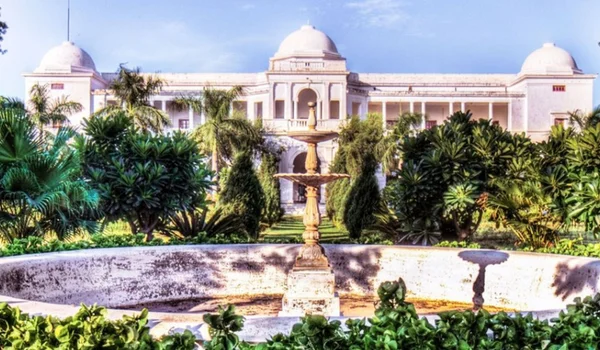
Pataudi Palace is located in the town of Pataudi in Haryana, within the wider Gurugram region.
Pataudi is situated away from the dense urban environment of central Gurugram, giving the palace a comparatively peaceful setting. The property is surrounded by landscaped grounds and open spaces, which contribute to its traditional royal-estate character.
The location also makes Pataudi Palace relevant to travellers exploring heritage destinations around Gurugram and southern Haryana.
For visitors coming from Delhi or Gurugram, road travel is generally the most practical way to approach Pataudi.
History of Pataudi Palace
The history of Pataudi Palace is closely connected with the Pataudi princely state and the later generations of the Pataudi family.
The palace was commissioned by Nawab Ibrahim Ali Khan, the eighth Nawab of Pataudi, and was completed in 1935.
The project was undertaken to create a grand new residence for the Pataudi family. The design was influenced by the large colonial mansions of New Delhi and combined European planning concepts with Indian architectural details.
The palace became the principal residence of the Pataudi family and remained an important symbol of the former princely state.
After Indian independence and the end of princely privileges, the palace continued to have a strong connection with the family. It later became particularly well known through the public lives of members of the Pataudi family, including former Indian cricket captain Mansoor Ali Khan Pataudi and actress Sharmila Tagore.
Who Built Pataudi Palace?
Pataudi Palace was commissioned by Nawab Ibrahim Ali Khan.
The architectural design is attributed to Robert Tor Russell, a prominent British architect associated with several important buildings in colonial-era New Delhi. Austrian architect Karl Malte von Heinz also worked on the palace.
The result was a large residential estate that differed from many traditional Mughal or Rajput palaces.
Instead, Pataudi Palace represents a later period of Indian royal architecture, when princely families increasingly adopted European and colonial architectural influences while retaining Indian decorative traditions.
Architecture of Pataudi Palace
The architecture of Pataudi Palace is one of its most distinctive features.
The building combines a grand colonial mansion style with Indian architectural elements.
Important features include:
- Large arched entrances
- Symmetrical building planning
- Domed elements
- Decorative archways
- Tall ceilings
- Large windows
- Long corridors
- Spacious reception areas
- Formal gardens
- Traditional furniture and artwork
The overall design reflects the architectural preferences of Indian princely families during the first half of the twentieth century.
Unlike much older palaces built around defensive walls, courtyards and traditional regional styles, Pataudi Palace has a more open mansion-like character.
The Royal Interiors
The interiors of Pataudi Palace provide an important part of the property’s identity.
The palace contains large rooms decorated with vintage furniture, chandeliers, paintings, family memorabilia and traditional decorative pieces.
Different generations of the Pataudi family have contributed to the collection of furniture and objects found within the residence.
The interiors therefore provide insight into the lifestyle of an Indian princely family during the twentieth century and the decades following independence.
The combination of European-style furniture and Indian decorative elements gives the palace a distinctive visual character.
Pataudi Palace and the Pataudi Family
The palace is inseparable from the history of the Pataudi family.
Mansoor Ali Khan Pataudi, popularly known as Tiger Pataudi, was one of India’s most prominent cricketers and captains. His association with the palace helped bring the property into the public imagination beyond Haryana.
The family has also had a strong connection with India’s film and cultural world through Sharmila Tagore and their children.
This combination of royal history, cricket and Bollywood has made Pataudi Palace one of the more recognisable private heritage residences in North India.
Pataudi Palace and Saif Ali Khan
Actor Saif Ali Khan, son of Mansoor Ali Khan Pataudi and Sharmila Tagore, is closely associated with the palace.
The property was leased for a period for hospitality use, after which it returned to the family’s direct control.
Saif Ali Khan subsequently undertook renovation work to update parts of the residence while retaining its historic character.
The palace continues to function primarily as a family property rather than a conventional public museum.
Was Pataudi Palace a Hotel?
For a period, Pataudi Palace was operated as a heritage hotel.
The palace was leased to Neemrana Hotels and was converted into a hotel between 2005 and 2014.
This phase demonstrated how a private royal residence could be adapted for hospitality while preserving its architectural identity.
The property later returned to the Pataudi family’s control.
It is therefore important not to describe Pataudi Palace as a currently operating hotel without checking the latest access arrangements. Its present status is primarily that of a private family residence.
Film and Popular Culture
Pataudi Palace has become particularly famous because of its use as a filming location.
Several Hindi films and entertainment productions have used the palace and its surroundings because of its royal interiors, gardens and distinctive architecture.
The property’s cinematic presence has increased its visibility among audiences who may never have visited Pataudi itself.
Its combination of large halls, traditional furniture, gardens and palace-style architecture makes it visually suitable for period-inspired scenes, family dramas and luxury settings.
This film connection has become an important part of the palace’s modern cultural identity.
Gardens and Outdoor Areas
The palace is surrounded by extensive landscaped grounds.
The gardens provide an open setting around the main building and help create the atmosphere of a large private royal estate.
The combination of lawns, mature trees, pathways and palace architecture makes the exterior particularly distinctive.
Outdoor areas have also contributed to the property’s appeal as a filming location and as a former heritage-hospitality venue.
Because the palace is a private property, access to gardens and other areas should not be assumed without prior permission.
Timings and Visitor Access
Pataudi Palace is not a conventional public monument with fixed daily sightseeing hours.
As a private royal residence, public access can depend on specific arrangements, events, filming permissions or hospitality programmes.
| Visitor Information | Details |
| Regular public opening | Not a standard public monument |
| Fixed sightseeing hours | Not generally applicable |
| Private access | Subject to permission or arrangement |
| Photography | Depends on access and property rules |
| Events/film shoots | Separate arrangements may apply |
Visitors should confirm the current access policy before planning a dedicated trip.
Entry Fee
Pataudi Palace does not operate like a regular government monument with a standard public entry ticket.
There is therefore no general monument-style entry fee that should be assumed for visitors.
If access is offered for a specific event, hospitality experience, private tour or other arrangement, charges and conditions can vary.
How to Reach Pataudi Palace
Road travel is the most practical way to reach Pataudi Palace.
From Gurugram
Pataudi can be reached by road from Gurugram through the surrounding highway and local road network.
From Delhi
Travellers from Delhi can reach Pataudi by road, with the journey time depending on the starting point and traffic conditions.
By Railway
Pataudi Road Railway Station provides railway connectivity to the surrounding area. Local road transportation is required for the final part of the journey.
By Air
Indira Gandhi International Airport in Delhi is the nearest major airport for travellers arriving by air.
A taxi or private vehicle can be used for the onward road journey.
Nearby Places to Visit
Pataudi Palace is located in a region where visitors can combine heritage exploration with nature and recreational attractions.
Pataudi Town
The town itself provides an opportunity to experience the local character of the former princely-state area.
Sultanpur National Park
Located in the wider Gurugram region, Sultanpur National Park is known for its wetland habitat and birdlife.
Heritage Areas Around Gurugram
Visitors interested in architecture and history can explore other historic structures and cultural sites around the wider Gurugram and Haryana region.
Gurugram
Modern Gurugram provides shopping centres, restaurants, hotels and entertainment venues, making it a useful base for travellers combining business and heritage tourism.
Tourism Importance of Pataudi Palace
Pataudi Palace contributes to the heritage tourism identity of Haryana.
Unlike Rajasthan, which has a large concentration of famous palace hotels and public royal monuments, Haryana has comparatively fewer widely recognised royal properties.
Pataudi Palace therefore stands out because of its combination of princely history, twentieth-century architecture and association with famous public figures.
Its proximity to Delhi and Gurugram also gives it potential relevance for weekend heritage tourism.
The palace’s film appearances have further increased its recognition among domestic travellers.
Business and Hospitality Perspective
Pataudi Palace provides an interesting example of adaptive use in the heritage-hospitality sector.
Its period as a heritage hotel showed how a private royal residence could be used commercially while maintaining much of its original character.
Such properties can generate value through accommodation, food services, events, photography, film production and destination experiences.
However, Pataudi Palace should currently be understood primarily as a private family property rather than assuming that hotel services or commercial visitor access are continuously available.
Weddings and Events
Royal residences often attract interest from wedding planners and event organisers because of their architecture, gardens and cultural atmosphere.
Pataudi Palace’s large estate and royal identity have made it particularly attractive for high-profile private functions and filming.
However, event access is not equivalent to permanent public access. Any wedding, private celebration, photography session or commercial event would depend on separate arrangements and permissions.
Visitors should not assume that the property functions as an open wedding venue throughout the year.
Finance and Investment Perspective
Pataudi Palace also illustrates the difference between a heritage residence and a conventional commercial property.
A historic royal estate can carry substantial cultural and architectural value, but maintaining a large property can require significant expenditure.
Costs may include structural maintenance, landscaping, restoration of decorative elements, utilities, security and preservation of historic furniture and interiors.
For heritage investors, adaptive reuse can create commercial opportunities, but ownership rights, heritage considerations, restoration costs and long-term operating requirements must be assessed carefully.
No specific property valuation or investment return should be assumed without verified financial information.
Insurance Considerations
Large historic residences can face risks that differ from those of ordinary homes.
General insurance considerations can include:
- Fire and property damage
- Public liability
- Theft and security risks
- Damage to valuable artwork and furniture
- Event-related liability
- Equipment risks
- Business interruption where commercial activity is involved
- Restoration-related risks
Historic furniture, artwork and architectural features can also require specialised valuation and protection.
These are general considerations and do not confirm the insurance arrangements of Pataudi Palace.
Best Time to Visit the Pataudi Area
The cooler months are generally more comfortable for travelling around Haryana and exploring outdoor attractions.
Winter is particularly suitable for combining a visit to the Pataudi area with nearby destinations and nature attractions.
Morning and late-afternoon travel can be more comfortable during warmer periods.
Visitors planning a private or organised palace experience should prioritise the access schedule over seasonal sightseeing preferences.
Things to Know Before Visiting
Before planning a visit to Pataudi Palace, keep these points in mind:
- Pataudi Palace is a private royal residence.
- It is not a standard public monument with unrestricted daily access.
- Do not assume that the palace is currently operating as a hotel.
- Entry requires appropriate permission or a valid arrangement where applicable.
- Photography and filming may be subject to specific rules.
- Road travel is generally the most practical way to reach Pataudi.
- The palace can be combined with attractions in the wider Gurugram region.
- Visitors should verify current access arrangements before travelling specifically to the property.
FAQs
Where is Pataudi Palace located?
Pataudi Palace is located in Pataudi town in Haryana, within the wider Gurugram region.
Who built Pataudi Palace?
The palace was commissioned by Nawab Ibrahim Ali Khan and designed by Robert Tor Russell with Karl Malte von Heinz.
When was Pataudi Palace built?
The palace was completed in 1935.
Is Pataudi Palace still owned by the Pataudi family?
The palace remains associated with the Pataudi family and is currently a private family property.
Can the public visit Pataudi Palace?
Pataudi Palace is not a regularly open public monument. Access depends on specific permissions, arrangements or organised activities.
Was Pataudi Palace used as a hotel?
Yes. The palace was leased for heritage-hotel operations for a period, but it should not automatically be considered a currently operating hotel.
Final Thoughts
Pataudi Palace is one of Haryana’s most recognisable royal residences and an important part of the heritage identity of the Pataudi region. Completed in 1935 for Nawab Ibrahim Ali Khan, the palace reflects the architectural transition of Indian princely residences during the colonial period. Its design by Robert Tor Russell and Karl Malte von Heinz combines European mansion-style planning with Indian decorative influences, creating a character that is different from the older fort-palaces of Rajasthan.
The palace’s importance has also grown through its association with the Pataudi family, cricket legend Mansoor Ali Khan Pataudi, Sharmila Tagore and later generations of the family. Its appearances in films have added another dimension to its cultural popularity. Although it has previously been used as a heritage hotel, Pataudi Palace is primarily a private family residence today. Its history, architecture, royal connections and cinematic identity make it a notable heritage property near the Delhi-NCR region.